Judging fleece at New Hampshire Sheep and Wool Festival
At my first New Hampshire Sheep and Wool festival with Guido, I was shocked when he confessed a certain attraction to the idea of raising sheep. Why on earth would you do that? Raising livestock reduces your stitching time!
Not one year later, Barb Parry‘s husband told the story of the day his wife came home with animals to graze in the back yard. Hanging around fiber animals produces a contagious desire to care for them, I gathered. Flockitis?
While I am far from interested in becoming a shepherd, attending Lucy Lee’s FiberCamp 2012 talk made me realize that I did want a fleece. Now why on earth did I choose to go to that talk? That’s the fun of FiberCamp… you’ll never know what you’ll learn. No hurry for this fleece, just… when presented with the right situation, I wanted a fleece. Not flockitis, just a fantasy fleece!
The situation presented itself last fall in Wisconsin. I knew that one of my sister’s dear friends, Laura Stremick-Thompson was raising Shetlands on Blind Faith Farm. She and her husband acquired their first registered Shetland sheep in 2009. I thought they just planned on hobby farming. However, Laura and Jim expanded the flock, adding other breeds and crosses. Clearly, flockitis was in the air, as they witnessed the first lambs born on their farm in 2010. Their closed spinner’s flock now has 15 sheep, including primitive double coated and single coated Shetland, Shetland cross, Bluefaced Leicester/Icelandic and Clun Mule. As you can imagine by this list of breeds, Laura is careful and dedicated to her flock, hoping not only for quality fiber but high quality of life for her herd.
What a fluff ball, Rupert!
Stella won won first place in the Double Coat Division and third place overall in the Shetland category at the 2011 WI Sheep and Wool Festival, and placed again in 2012. Also in 2012, Rupert captured first place in the Shetland colored, double coat class. Two others received third place in their categories. Here’s Laura sharing the ribbons with her flock.
Last October, Laura had 2 Shetland fleeces left. The color ways of Spectacles and Buckaroo sounded good over the phone. Sight unseen, I purchased them and shipped them to Boston. Buying a fantasy fleece was too easy.
Buckaroo as a lamb
Spectacles a few months after shearing.
According to Laura, Spectacles gets his name not only from his dark eye marks, but for the spectacle he makes of himself! The fleeces were much better than my pessimistic, novice fleece processing expectations. So clean, so beautifully skirted and with nary a second cut, the bags of lanolin smelling woolliness waited through the winter. On a hot summer weekend, I put on my swimsuit and washed the fleeces in the bath tub. What a jolly time that was! There was great pleasure watching Specs’ fleece go from beige to fluffy white and the delicate grey patch on his back. Buckaroo wasn’t nearly as dirty, but carefully swishing the laundry bags filled with fleece was really pleasurable.
Buckaroo’s fleece, tawny and luscious, before washing
That’s not a shadow, that’s Spectacle’s grey markings
I took some of Buckaroo’s fleece to wet felt immediately for a quilt I’m making now. Wow, Shetland felts much more slowly than Merino or Silk. His fleece has a lovely depth that will be great for this series on childhood camping experiences.
I haven’t finished carding, but it will happen someday. Once combed, I have no idea what I will do with the rest of this fleece, but it makes me happy just looking at it around my studio for the time being!
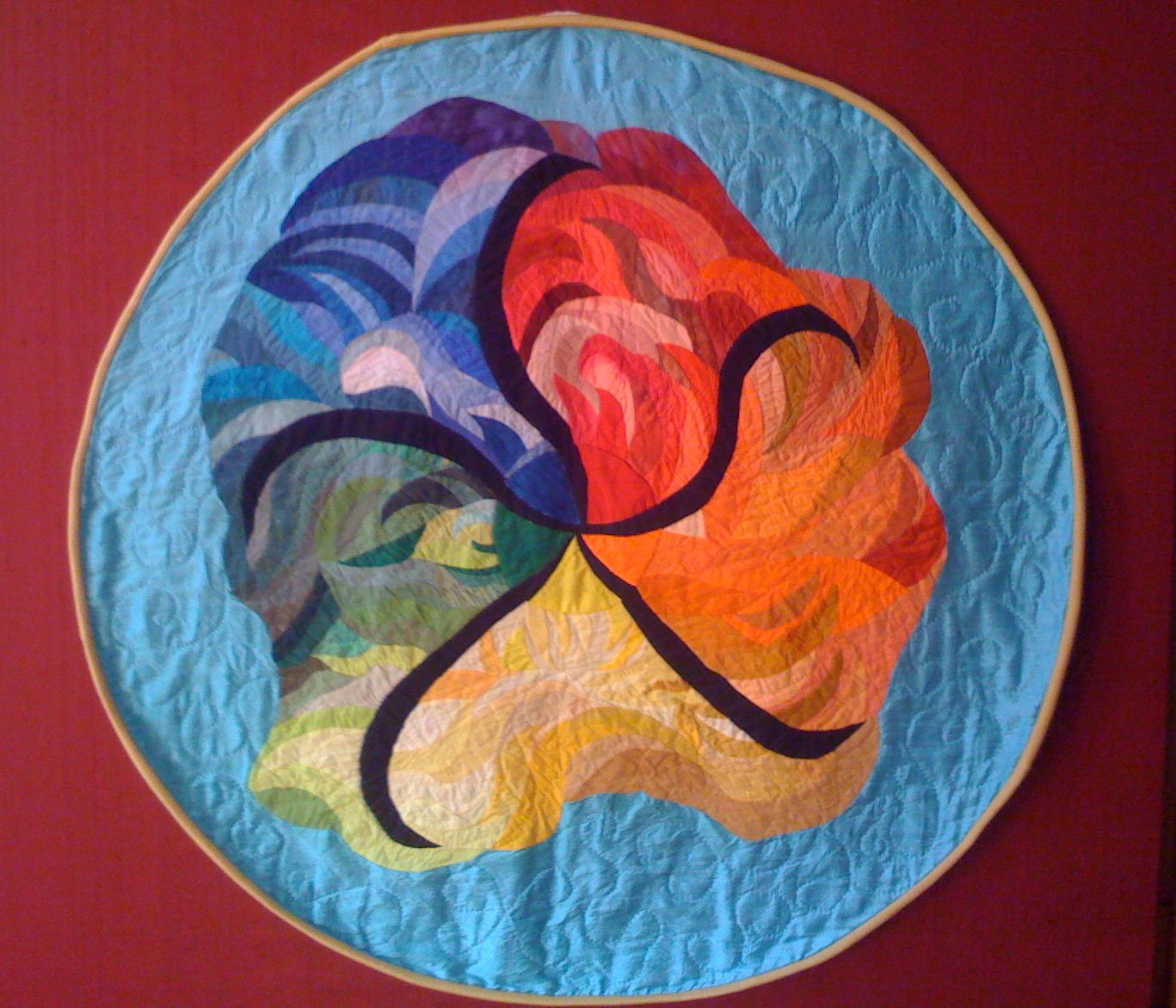
After processing all of Buckaroo’s fleece, I felted a portion to use in art quilts.
BlindFaithFarm has a shop at Etsy.com. In 2014, they plan to sell roving. If you’re interested in fleeces, catch Laura at the Wisconsin Sheep and Wool Festival next weekend, September 6 – 8, 2013, where her flock’s winning traditions will hopefully continue. Laura can also be reached at laurast25 at wi.rr.com. You, too, could have a fantasy fleece!
My wool collection includes yarns, threads, fleece and roving. On hot summer days, the latter two are some of my favorite toys. There’s something quite gratifying about putting on your swim suit and playing with soap, wool and water.
Needle felting is nice, but wet felting just brings out my beach instincts. In any case, I’m happy to include both in my art quilts.
Several of my recent art quilts use a felted background. It gives a lovely sense of multi textural goodness that contrasts with embroidery, quilting, applique and beading. For all of the fabric that I’ve dyed and painted, felting gives me a new dimension.
Here’s a background…
That became this quilt…
Earlier this week, my daughter’s college exploration took me to the Pioneer Valley. She considered my suggestion to fiber shop audacious. “Oh, no…don’t you have enough projects going now?”
She’s probably right, or we would have definitely stopped by New England Felting Supply in Eastborough to pick up some dyed quick felting merino roving. Felting has been a fun change of pace from my Master Knitter Focus this year.
I recently felted some undyed Shetland fleece and am here to report that merino felts much more quickly (however the end result was fabulous, pictures in a future post)! The slapping, stomping and throwing were undoubtedly excellent upper body work outs. If nothing else, I love playing with soapy water on summer day. It beats sitting in air conditioning, doesn’t it?
Word is getting out! More people are learning about the Melrose Adult Education program’s topics and signing up to learn painting, acting, business skills, interior design and craft. Yours truly will lead a basic knitting skills class on August 5 and 12 from 7 pm to 8:30
Basic Knitting Skills: Learn 2 ways to cast on, to knit, to purl, and how to bind off. Understand some of the most common abbreviations in knitting patterns and get ready to work on a basic knitting project! Bring light colored, smooth (no novelty yarns, please) worsted or bulky weight yarn and appropriate size of knitting needle. This class works for those who have never knit before, or need a refresher class. With your MCAE registration confirmation Sit ‘n Knit Melrose offers 10% discount on your class supplies. 7 – 8:30 p.m. Offered on Mondays August 5 and 12, 2013. COST: $25.00
I’ll also lead morning and evening sessions for Sit’n Knit’s boot camp series. Seaming knits, buttonholes and new ways to cast on and bind off will be the feature topics. I’ll let you know when registration is open for these Tuesday classes that begin August 13.
Fibercamp 2012: An inspiring open format conference for everyone who enjoys knitting, crochet and a whole host of other fiber arts. This year I learned about coiling from Jeanne and how to evaluate a fleece from Lucy. I also shared my experience with making a duct tape mannequin and enabled a session on seaming techniques for knitters.
We covered the seaming of (wish I had taken photos!)
ends of rows (e.g. the sides of a sweater),
cast on/bound off edges (e.g. shoulder seams)
cast on/bound off edge to an end of row (e.g. a shoulder cap)
I passed around samples and we talked about selvedges and ratios. Knowing that this might seem very logical while in the session, but completely irretrievable in the future, I put together a reference list based on magazines currently on the market, books I enjoy and books others recommended. Here they are:
From the current magazine stands, you’ll find a nice article about seaming in the Debbie Bliss Magazine. Knitters volume 106 has a super article on picking up stitches with a great table.
Amanda W then took the group through the principles of picking up stitches. Hopefully the short sessions gave people the jist and the resources for the next time they need to finish an project.
I’d love to hear any additions you have to the list!
The Common Cod Fiber Guild hosted their first Ignite Craft in 2011. “Ignite” events feature 5 minute slide shows, each slide on the screen for 15 seconds. You get all kinds of viewpoints on a subject. It was quite the entertaining and inspiring evening… if I do say so myself. I was Secretary of the Guild last year and took the opportunity to share a few of the quilts I’d made. Thanks to Brilliant Video, you can see both the 2011 and 2012 videos!



 (amazon associate link) by Nancie Wiseman. I love the spiral binding and way it fits in my knitting bag. Of course, this is on top of the wonderful explanations, drawing and photography.
 by Montze Stanley is a classic reference that always offers more than one way to do anything knitting!
 and of course, June Hiatt’s tomb and gravity source,
  .
.